Showing posts with label business history. Show all posts

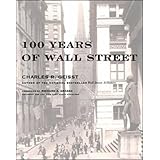
100 Years of Wall Street Review

100 Years of  Wall Street
Average Reviews:

(More customer reviews)
This book, rich with wonderful old photos, gives a concise history of the last 100 years of the financial culture that has come to be known as Wall Street. A good blend of text, photos, and charts make this book interesting to the non-financial reader.
The author divided the book into decades and each chapter outlined the changes that occurred over those years.
At the beginning of the last century, Wall Street was known for its lack of financial regulation regarding trades. Scandals and outright swindles abounded. Four years after the Crash of 1929, FDR's administration passed nationwide banking and securities laws to make sure that this kind of disaster did not happen again.
Unfortunately, the real and distasteful inner workings of Wall Street were revealed in the Senate hearings. An SEC commissioner called investment bankers "financial termites". This knowledge scared investors away for the next 20 years.
In the early 50s, investing became popular with middle class investors for the first time in a generation, and mutual funds were developed after being gone for 30 years.
The 60s brought the birth of the modern mergers and acquisitions business in the U.S, and the days of small brokerage firms were coming to an end.
The 70s brought extensive reforms concerning commissions while the 80s were the years of junk bonds, insider trading scandals, and the savings and loan crisis.
The author called the 80s the decade of greed and the 90s the decade of boom. The Internet has brought about a totally new way of trading stocks and has made up-to-the-minute financial news available to everyone.
The changes in the last 100 years on Wall Street have been phenomenal, mirroring the technological changes in our society.

Click Here to see more reviews about: 100 Years of Wall Street


Buy NowGet 34% OFF

Click here for more information about 100 Years of Wall Street

Read More...

When Genius Failed: The Rise and Fall of Long-Term Capital Management Review

When Genius Failed: The Rise and Fall of Long-Term Capital Management
Average Reviews:

(More customer reviews)
A somewhat didactic narrative history of the hedge fund Long Term Capital Management. Nicholas Dunbar covers the same subject in his book "Inventing Money." Both books present a blizzard of details about who did what and when. Too much detail. The general reader would better served by a medium sized article. Nevertheless if you're a finance buff interested in the nitty-gritty then read both books. Dunbar has a physics background and his book is more technical, while Lowenstein comes from journalism and his narrative flows better.
LCTM began operating in 1994, set up by John Meriwether formally head of the bond-arbitrage group at Solomon Brothers. He put together a star-studded cast that included three (1997) Nobel prize winners in economics. Their basic strategy was something called convergence arbitrage. In essence this strategy says buy two bonds that you think will track one another. Go long on the cheap one and short on the other; you make money if the spread narrows. In theory you are protected from changing prices as long as the two vary in the same way. To make the big bucks LCTM was after they took a gigantic number of highly leveraged arbitrage positions all over the world. To get high leverage you borrow for the position, like buying a stock on margin. LCTM got really high leverage by avoiding something called the "haircut," which is an extra margin of collateral banks usually demand, but forgave LCTM. Why would banks they do such a thing? Because they were blinded by the glitter of the cast, and in some cases the banks themselves were investors in LCTM. By 1997 convergence arbitrage opportunities in bonds began to dry up, everyone was doing it. So LCTM applied their strategy to stocks. Find two stocks that will track on another and go long and short with borrowed money. This is not easy. Stocks are less amenable to mathematical analysis than bonds, and after all these were the bond guys from Solomon, they were out of their depth. You might ask how can you borrow most of your stock position when the Federal Reserve requires 50% margin (Regulation T). Answer: don't really buy the stocks, instead buy derivative contracts that simulate stocks, an end run around Regulation T. Even with all this leverage LCTM would claim that the fund was no more risky than the stock market, meaning a stock index. In 1998 the markets went against LCTM, with the "flight to quality" (US government bonds) as investors panicked. The fund suffered from what reliability engineers call "common mode error." Spreads got wider not narrower across the board, and LCTM's capital base began to shrink as their positions lost money. At a certain point they would have to start liquidating positions, and the market impact of such large scale selling would cascade across their portfolio. The fund would "blow up."
The above gives a flavor of the material Lowenstein provides, only in much greater detail. If that's what you want, buy the book. Is this a tale of human folly or just plain bad luck? Answering that question is not easy, one needs to grasp a large amount of technical finance theory, and understand what happened in the particular case of LCTM. This book will help.

Click Here to see more reviews about: When Genius Failed: The Rise and Fall of Long-Term Capital Management


Buy NowGet 36% OFF

Click here for more information about When Genius Failed: The Rise and Fall of Long-Term Capital Management

Read More...