Showing posts with label cultural. Show all posts

Africans and Native Americans: The Language of Race and the Evolution of Red-Black Peoples Review

Africans and Native Americans: The Language of Race and the Evolution of Red-Black Peoples
Average Reviews:

(More customer reviews)
This book used historical sources from explorers, priests, and colonizers to describe the appearance of the indigenous peoples found in the Americas in the 14th, 15th, 16th centuries. From the witnesses own descriptions these people were dark copper-toned woolly-haired peoples often referred to by the witnesses as ethiopian and or negro. These are the ancestors so many so-call African-American elders spoke of to their children and grandchildren. This book should be required reading as well as be on every "black" family's book shelf. A fascinating read without the politics of the western scholar. I would also suggest another book entitled When Rocks Cry Out by Horace Butler.

Click Here to see more reviews about: Africans and Native Americans: The Language of Race and the Evolution of Red-Black Peoples


Buy NowGet 12% OFF

Click here for more information about Africans and Native Americans: The Language of Race and the Evolution of Red-Black Peoples

Read More...

Parading through History: The Making of the Crow Nation in America 1805-1935 (Studies in North American Indian History) Review

Parading through History: The Making of the Crow Nation in America 1805-1935 (Studies in North American Indian History)
Average Reviews:

(More customer reviews)
This well researched text provides great insight into the Crow Indian culture. Beginning with earliest recorded written accounts, proceding through the forced move of the Crow, or Apslaloke, from historic homelands and concentrated on their modern day reservation, this is an excellent introduction or supplement to a basic understanding of this plains nation. There is a lot of first person quotes, good photo documentation and scholarly posings. The book concludes with a interesting analysis of Chief Plenty Coups presentation at the dedication of the tomb of the unknown soldier and it's meaning as representative of Native American society at that time.

Click Here to see more reviews about: Parading through History: The Making of the Crow Nation in America 1805-1935 (Studies in North American Indian History)

This history of the Crow Indians links their nineteenth-century nomadic life and their modern existence. The Crows not only withstood the dislocation and conquest visited on them after 1805, but acted in the midst of these events to construct a modern Indian community--a nation.Their efforts sustained the pride and strength reflected in Chief Plenty Coups' statement in 1925 that he did "not care at all what historians have to say about Crow Indians," as well as their community's faith in the beauty of its traditions and its inventions. Frederick E. Hoxie demonstrates that contact with outsiders drew the Crows together and tested their ability to adapt their traditions to new conditions.He emphasizes political life, but also describes changes in social relations, religious beliefs, and economic activities.His final chapter discusses the significance of the Crow experience for American history in general.

Buy NowGet 6% OFF

Click here for more information about Parading through History: The Making of the Crow Nation in America 1805-1935 (Studies in North American Indian History)

Read More...

Crowfoot: Chief of the Blackfeet (Civilization of the American Indian) Review

Crowfoot: Chief of the Blackfeet (Civilization of the American Indian)
Average Reviews:

(More customer reviews)
This book is interesting, adventurous, informative, accurate, captivating - a must read! It involves North American Indian history during the last half of the 1800's, in the Northwest US and Western Canada. The major focus is on the Blackfeet Indians of this area. Learn how critical the land and the buffalo were to so many Indian Nations, and how they lost both of these critical necessities of their life and culture. Read this book and learn that there were peaceful Indians, and there were violent Indians, rather like the rest of the world! Read this book and you will never think or say the North American Indians "were savages", as many people still do! This book should also be a must read for every high school student in North America! I highly recommend it!

Click Here to see more reviews about: Crowfoot: Chief of the Blackfeet (Civilization of the American Indian)

Crowfoot, a Blood Indian who became chief of the Blackfoot Nation, was a great warrior and peacemaker during the time of settlement of the Canadian West.In one shattering decade, from 1875 to 1885, the great buffalo herds disappeared from Western Canada, forcing the Plains Indians who had depended on them for food, shelter, and clothing, to change their way of life.Crowfoot became a leader by merit, establishing his leadership in battle.He survived smallpox epidemics, fought in 19 battles, and provided generous leadership, sharing his wealth with the less successful.Crowfoot tells the story of how one Canadian First Nation was led through years of cataclysmic change by a wise chief, a great warrior, a diplomat and peacemaker who viewed peace as the key to survival.--This text refers to an alternate Paperback edition.

Buy Now

Click here for more information about Crowfoot: Chief of the Blackfeet (Civilization of the American Indian)

Read More...

Story, Performance, and Event: Contextual Studies of Oral Narrative (Cambridge Studies in Oral and Literate Culture) Review

Story, Performance, and Event: Contextual Studies of Oral Narrative (Cambridge Studies in Oral and Literate Culture)
Average Reviews:

(More customer reviews)
Richard Bauman presents a collection of essays that employ the use of performance theory. He analyzes a range of topics, and my favorite essays deal with tall tales and narratives told by coon-hunters in Texas. The work is solid scholarship, and he provides empirical ways of researching and interpreting various forms of verbal expression. The collection may be most useful as models for additional studies, and there is a great variety of research topics evoked what Bauman discusses. At times, however, the conclusions are less-than earth-shattering, and the theoretical apparatus tends to get in the way of developing important conclusions and offering insight into why these conclusions are significant. Despite the limitations, this is a good volume of articles on folklore.

Click Here to see more reviews about: Story, Performance, and Event: Contextual Studies of Oral Narrative (Cambridge Studies in Oral and Literate Culture)

Based on a corpus of Texan oral narratives collected by the author over the past fifteen years, this study presents an analysis of the literary qualities or orally performed verbal art, focusing on the significance of its social context. Although the tales included are all from Texas, they are representative of oral storytelling traditions in other parts of the United States, including tall tales, hunting stories, local character anecdotes, accounts of practical jokes, and so on. They are also highly entertaining in their own right. Professor Bauman's main emphasis is on the act of storytelling, not just the text. His central analytical concern is to demonstrate the interrelationships that exist between the events recounted in the narratives (narrated events), the narrative texts, and the situations in which the narratives are told (narrative events). He identifies these interrelationships by combining a close formal analysis of the texts with an ethnographic examination of the way in which their telling is accomplished, paying particular attention to the links between form and function. He also illuminates other more general concerns in the study of oral narrative, such as stability and variation in the oral text, the problem of genre, and the rhetorical efficacy of literary forms. As an important contribution to the theoretical and practical literary analysis of orally performed narratives, the book will appeal to students and teachers of folklore, sociolinguistics and linguistic anthropology, and literary theory.

Buy Now

Click here for more information about Story, Performance, and Event: Contextual Studies of Oral Narrative (Cambridge Studies in Oral and Literate Culture)

Read More...

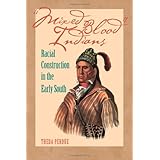
Mixed Blood Indians: Racial Construction in the Early South (Mercer University Lamar Memorial Lectures) Review

Mixed Blood Indians: Racial Construction in the Early South (Mercer University Lamar Memorial Lectures)
Average Reviews:

(More customer reviews)
Excellent book filled with info about various southern tribes surnames; especially within the Cherokee. If you are researching family connections within your tree, I highly recommend. An interesting and easy read.

Click Here to see more reviews about: Mixed Blood Indians: Racial Construction in the Early South (Mercer University Lamar Memorial Lectures)


On the southern frontier in the eighteenth and early nineteenthcenturies, European men—including traders, soldiers, and governmentagents—sometimes married Native women. Children of these unions wereknown by whites as "half-breeds." The Indian societies into which theywere born, however, had no corresponding concepts of race or "blood."Moreover, counter to European customs and laws, Native lineage wastraced through the mother only. No familial status or rights stemmedfrom the father.

"Mixed Blood" Indians looks at a fascinatingarray of such birth- and kin-related issues as they were alternatelymisunderstood and astutely exploited by both Native and Europeancultures. Theda Perdue discusses the assimilation of non-Indians intoNative societies, their descendants' participation in tribal life, andthe white cultural assumptions conveyed in the designation "mixedblood." In addition to unions between European men and Native women,Perdue also considers the special cases arising from the presence ofwhite women and African men and women in Indian society.

From thecolonial through the early national era, "mixed bloods" were often inthe middle of struggles between white expansionism and Native culturalsurvival. That these "half-breeds" often resisted appeals to their"civilized" blood helped foster an enduring image of Natives as fickleallies of white politicians, missionaries, and entrepreneurs. "MixedBlood" Indians rereads a number of early writings to show us theNative outlook on these misperceptions and to make clear that race istoo simple a measure of their—or any peoples'—motives.


Buy NowGet 4% OFF

Click here for more information about Mixed Blood Indians: Racial Construction in the Early South (Mercer University Lamar Memorial Lectures)

Read More...

The Blackfeet: Raiders on the Northwestern Plains (Civilization of the American Indian Series) Review

The Blackfeet: Raiders on the Northwestern Plains (Civilization of the American Indian Series)
Average Reviews:

(More customer reviews)
This book is a researcher's dream, and a pleasure to read. First published in 1958, this volume traces the history of the Blackfeet from pre-horse days through to the 1950's. The author displays a thorough understanding of his subject, and extensively annotates his work, paying meticulous attention to dates, places and names. John C Ewers was the first curator of the Museum of the Plains Indian near Browning, Montana, and many of the items in the museum collection were given to him at the time by elder members of the tribe at the time. He used primary sources for much of his information for this book, and corroborated details with these tribal elders as much as possible. This is a well-written, respectful history of the Blackfeet nation, and ought to remain in print for decades to come. Potential buyers should scan the Table of Contents page for an overview of subjects covered.

Click Here to see more reviews about: The Blackfeet: Raiders on the Northwestern Plains (Civilization of the American Indian Series)


The Blackfeet were the strongest military power on the northwestern plains in the historic buffalo days. For half a century up to 1805, they were almost constantly at war with the Shoshonis and came very close to exterminating that tribe. They aggressively asserted themselves against the Flatheads and the Kutenais, shoving them westward across the Rockies. They got on fairly well with English and Canadian traders during the heyday of the fur trade on the Saskatchewan River, but on the upper Missouri they took an early dislike to Americans, whom they called "Big Knives." American fur traders, such as Manuel Lisa, Pierre Menard, and Andrew Henry, were literally chased out of Montana by the Blackfeet.


Buy NowGet 21% OFF

Click here for more information about The Blackfeet: Raiders on the Northwestern Plains (Civilization of the American Indian Series)

Read More...

Mule Trader: Ray Lum's Tales of Horses, Mules, and Men (Banner Book Series) Review

Mule Trader: Ray Lum's Tales of Horses, Mules, and Men (Banner Book Series)
Average Reviews:

(More customer reviews)
Ray Lum's tells a pretty good set of stories in this book. The books format was concise and easy to follow and Lum's stories relate well with the comings and goings of the horse and mule market of the 30's, 40's and 50's. This is a very entertaining read, especially for those Ben Green fans who need some more material. The only drawback comes when Lum starts skipping around in his stories and gets the reader a little lost. But, he is always able to bring the reader back and finish the original story.

Click Here to see more reviews about: Mule Trader: Ray Lum's Tales of Horses, Mules, and Men (Banner Book Series)

Story after wonderful story, tall tale after tall tale. Ray Lum tells a southern writer where he came from, and where he ought to go. -Shelby Foote Bill Ferris makes me wish I'd known Ray Lum. -Larry Brown Indeed, the mule trader has undoubtedly helped to form our great oral tradition in the South . Ray Lum [was] a man born and bred to the practice of the country monologue. -Eudora Welty
Readers captivated by this book will be happy that Bill Ferris found Ray Lum and that he thought to turn on a tape recorder. Lum (1891--1977) was a mule skinner, a livestock trader, an auctioneer, and an American original. This delightful book, first published in 1992 as You Live and Learn. Then You Die and Forget It All, preserves Lum's colorful folk dialect and captures the essence of this one-of-a-kind figure who seems to have stepped full-blooded from the pages of Mark Twain. This riveting talespinner was tall, heavy-set, and full of body rhythm as he talked. In his special world he was famous for trading, for tale-telling, and for common-sense lessons that had made him a savvy bargainer and a shrewd businessman. His home and his auction barn were in Vicksburg, Mississippi, where mules were his main interest, but in trading he fanned out over twenty states and even into Mexico. A west Texas newspaper reported his fame this way: He is known all over cow country for his honest fair dealing and gentlemanly attitude..... A letter addressed to him anywhere in Texas probably would be delivered. Over several years Ferris recorded Lum's many long conversations that detail livestock auctioneering, cheery memories of rustic Deep South culture, and a philosophy of life that is grounded in good horse sense. Even among the most spellbinding talkers Lum is a standout both for what he has to say and for the way he says it. Ferris's lucky, protracted encounters with him turn out to be the best of good fortune for everybody. William R. Ferris is the former director of the Center for the Study of Southern Culture at the University of Mississippi. Among his many awards are the NEH's Charles Frankel Prize and in 1991 Rolling Stone's citation of him as one of the top ten teachers in the United States.

Buy Now

Click here for more information about Mule Trader: Ray Lum's Tales of Horses, Mules, and Men (Banner Book Series)

Read More...